 |
 |
 |
|
- High Sensitivity Monoclonal Antibody Pair
- Calibration by human Glycosylated Irisin (HEK293)
- Best Cited Irisin ELISA SK00170-08
- More reliable and specific via the competitive Irisin ELISA
- Size: 96T, 192T ($1040 per 192T), 480T ($2490 per 480T)
- Available in Stock.
- Updated Data Sheet: SK00170-08
The Most Cited Irisin Double Monoclonal Antibody Formulated ELISA Kit: - Gonzalez-Gil AM, et al. Myokine-adipokine cross-talk: potential mechanisms for the association between plasma irisin and adipokines and cardiometabolic risk factors ... . Diabetol Metab Syndr. 2019 Aug 5;11:63. doi: 10.1186/s13098-019-0458-2. eCollection 2019
- Anna S. Huerta-Delgado, et al, "Serum Irisin Levels, Endothelial Dysfunction, and Inflammation...", Journal of Diabetes Research, vol. 2020, Article ID 1949415, 16 pages, 2020.
- Śliwicka E, et al. Effects of marathon race on selected myokines and sclerostin in middle-aged male amateur runners. Sci Rep. 2021 Feb 2;11(1):2813.
- Zhang, Feng et al. “Serum Irisin as a Potential Biomarker for Cognitive Decline in Vascular Dementia.” Frontiers in neurology vol. 12 755046. 13 Sep. 2021, doi:10.3389/fneur.2021.755046
Irisin Research:
- Eunhee Kim, et al. Irisin reduces amyloid-b by inducing the release of neprilysin from astrocytes following downregulation of ERK-STAT3 signaling. Neuron 111, 3619–3633, November 15, 2023.
- Nie Y, Liu D. N-Glycosylation is required for FDNC5 stabilization and irisin secretion. Biochem J. 2017 Sep 7;474(18):3167-3177. doi: 10.1042/BCJ20170241. PMID: 28733331.
- Korta, P.; Pocheć, E.; Mazur-Biały, A. Irisin as a Multifunctional Protein: Implications for Health and Certain Diseases. Medicina 2019, 55, 485.
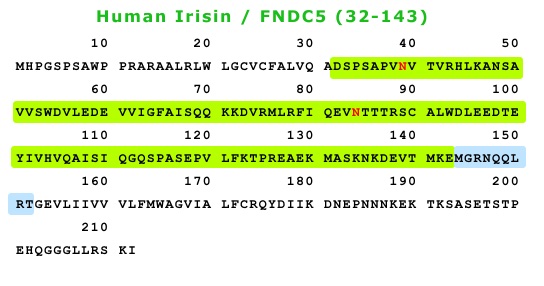 Nie Y, Liu D. N-Glycosylation is required for FDNC5 stabilization and irisin secretion. Biochem J. 2017 Sep 7;474(18):3167-3177. doi: 10.1042/BCJ20170241. PMID: 28733331. Nie Y, Liu D. N-Glycosylation is required for FDNC5 stabilization and irisin secretion. Biochem J. 2017 Sep 7;474(18):3167-3177. doi: 10.1042/BCJ20170241. PMID: 28733331.Irisin, a myokine derived from the extracellular domain of FNDC5, has been shown to mediate thermogenesis of white adipose tissue. Biochemical data have shown that N-glycosylation of FNDC5 is unlikely to affect ligand or receptor activation of irisin. The N-glycosylation of FNDC5 remains poorly understood. In the present study, we analysed N-glycosylation sites of FNDC5 and found that two potential N-glycosylation sites (Asn36 and Asn81) could indeed be occupied by N-glycan. Furthermore we showed that the lack of N-glycosylation decreases the secretion of irisin, which is relevant to the instability of FNDC5 and the deficiency of cleavage of the signal peptide. We also found that the expression level of N-glycosylated FNDC5 was elevated after myoblast differentiation. These findings show that the secretion of irisin is modulated by N-glycosylation, which in turn enhances our understanding of the secretion of glycosylated irisin.
Korta, P.; Pocheć, E.; Mazur-Biały, A. Irisin as a Multifunctional Protein: Implications for Health and Certain Diseases. Medicina 2019, 55, 485. Irisin also has two N-glycosylation sites located at Asn-7 and Asn-52 positions. Deglycosylation of irisin lowers its molecular weight to 12 kDa or 15 kDa. The addition of one or two sugar chains increases its mass to 22 kDa or 25 kDa, respectively. Both N-glycans are probably important to the primary function of irisin in the browning of adipocytes, which was evident by an up-regulation of mitochondria uncoupling protein-1 (UCP-1) expression and its transcriptional factor peroxisome proliferator-activated receptor γ (PPARγ) coactivator-1α (PGC-1α) in the presence of irisin. Glycans do not affect the formation of irisin dimers.
|
|
|
 |
|
 |
|
|
|
 |
|
 |
|
Features
Irisin (Human) ELISA Kit Code: SK00170-08 Size: 96 T Standard Range: 200 - 12800 pg/ml Sensitivity: 50 pg/ml Specificity: Human
Calibration: human Irisin derived from human cells Sample Type: serum, plasma Dilution Factor: 8~32 Sample Requires: 100 ul per well Intra-CV: 4-6% Inter-CV: 4-9% Monoclonal Antibody was validated by human Irisin derived HEK293 cells on WB
|
|
|
|
|
|
|